



021 310 5469
pavilion@pavilionmagazine.org
www.pavilioncenter.ro
PAVILION functioned in Piața Victoriei, at the ground floor of a “hruschiov” type apartment building – named after the communist leader of the USSR during the 1960s. Today, as programatically, the center is surrounded by buildings which are emblematic to the type of architecture specific to Bucharest during the interwar period and it is also within close distance from the academic centre of the city. The building in which the center currently runs its activity is included in the list of historical monuments and the area surrounding it is part of the designated protected area “C.A. Rosetti – Maria Rosetti”. Having been built at the end of the 19th century, the building has had a number of different uses throughout its existence: as a Rheumatological care center, bank headquarters and as a cultural center, currently.
In essence, Bucharest is a palimpsest city. The traces of its history are interweaved with its structure and the conglomeration of different styles marks for a typology that is different to other European cities. C.A. Rosetti street bears features which are characteristic to the way the city has developed over time, from the boom of the French influence expressed in the presence of buildings belonging to the neoclassical and eclectic styles with Romanian accents, to the presence of interwar modernist architecture. The street used to link the center of the city with the periphery of the former slums, as it represents the area between Magheru Boulevard and Calea Moșilor. The whole area was marked down by transitions as it was inhabited by guilds, the aristocracy of the end of the century and also the bourgeoisie, which longed for affirmation.
PU is a work-in-progress independent space, a space for the production and research in the fields of audiovisual, discursive and performative. It is a space of the critical thinking, and it promotes an artistic perspective implying the social and political involvement of the art and of the cultural institutions.
Nevertheless, the basic function of the space will remain the concretization.
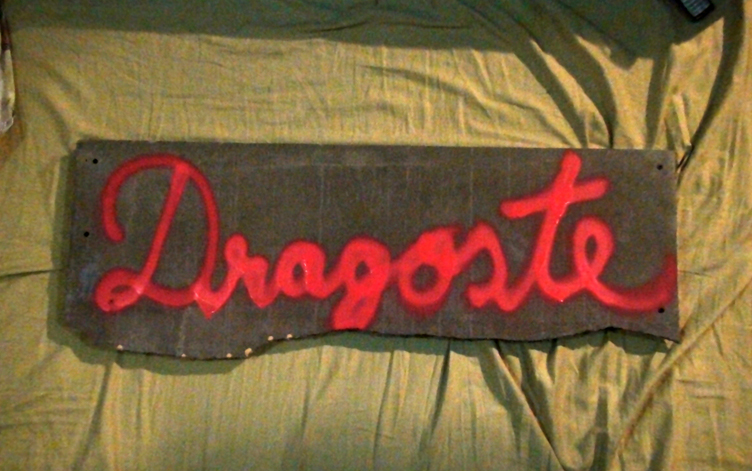
Common Nostalgia
22:00 - 03:00exhibition
curator: Eugen Rădescu
participants: Dan Raul Pintea (RO), Ștefan Sava (RO), Nicolae Constantin Tănase (RO), Swel Noury (MAR)
Nostalgia shackles the exercise of the future. Nostalgia, by definition enforces the abdication of perspective and re-penetration of the past. It is some sort of melancholy driven by the wish of re-seeing something or someone from the past; such as when the nostalgic subject goes on with the narcissist identification with the lost object/place; and this subject remains faithful to the lost object, with a pathological wish of not giving up this attachment.
Nostalgia is nor fado, nor the romantic swiss term of “kuhreihen”. I see it more as an “ostalgie”. A common sense of a loss, of a regret – full of demons. I emphasize the antihegelian side of the nostalgia, because the “mourning” and the consciousness of the comeback to the past has the structure of the “overflow” from which the essence of the notion of an object/being is kept. This is how the “mourner” grieves the lost object and “kills it the second time” by the typification and concretisation of its loss. The nostalgic isn’t the one who hasn’t got the power to give up of that something from the past, on the contrary, he “kills the second time” before the object is lost for good.
In the exhibition “Common nostalgia”, which will be open between the 4th of April and the 7th of July 2013, I started from the premise that the subjectifying of the loss and the objectifying of the feeling of losing something could reduce the consistency of the nostalgic type of living, because the exhibited works assume to reach all means of the idea of nostalgia. From “love”, a feeling coming from a casual past, which becomes the subject of what can be assimilated, to the “ostalgie” of the family memories, microcosmos, of a place with your own people. (“Ostalgia” is a sociological german term coming from “nostalgia” and “ost” which means “east”, therefore a nostalgia of the East, in its geopolitical meaning. (Eugen Rădescu).
Eveniment NAG
Open air hopscotch:
22:30 - 03:00all
The best player will be rewarded with books from our PAVILION RESOURCE ROOM.
Every player will be rewarded with a copy of Reforma newspaper, Pavilion #15 and a Bucharest Biennale shopping bag.
Registration until 22.00
Eveniment NAG
After-art party
22:00 - 03:00
Powered by Reforma (www.re-forma.ro)
The beautiful terrace will be open until dawn. Music mix by PAVILION & REFORMA team.
We do not sell drinks, but everyone is free to bring their own drinks.
Eveniment NAG
Marina Albu / Scape Goats and Escapist Artists
22:00 - 22:30all
Site-specific intervention and performance
Everything is elopement, from or towards. We are somewhere and want to be someplace else. This does not please me, this does not please me, that other situation does not suit me well. The artist is a better escaper, he creates his own worlds and his own emergency exits. ”Where there is dispersion in space there cannot be concentration and where is concentration there cannot be occupation of territory” or something of the like, said Octav citing a philosopher – or this is what I understood of it.
Let us see our margins (and how often we runaway from them)!
Let us acknowledge what remains after the deduction of all the running and the jogging!
I will wait for you in the balcony, to do this jointly for half an hour!
At 22 sharp.
As ever,
Marina